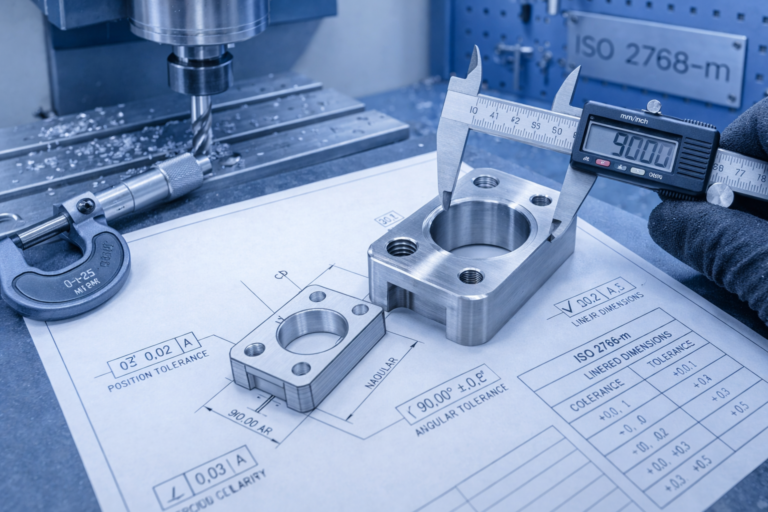
Standard fabrication equipment seems like the obvious choice for most manufacturing operations. It’s readily available, proven, and familiar. Yet when production demands grow complex or customization becomes critical, standard solutions quickly reveal their limitations. Custom fabrication offers manufacturers in Nordic and Western Europe a strategic advantage by delivering precision, compliance, and flexibility that standard equipment simply cannot match. This guide explores why custom fabrication has become essential for advanced manufacturing in 2026 and how it transforms production efficiency and product customization.

Table of Contents

Key takeaways

Point Details
Precision and compliance Custom fabrication enables exact specifications and regulatory adherence for complex manufacturing needs
Mass customization capability Advanced custom lines in Nordic Europe achieve high volume production while maintaining flexibility
Modular and hybrid optimization Combining modularity with hybrid manufacturing reduces costs, parts count, and production complexity
Lower total ownership cost Despite higher upfront investment, custom solutions deliver superior long-term value through efficiency gains
Sustainability advantage Industry 4.0 integration and waste reduction make custom fabrication the environmentally responsible choice

Understanding custom fabrication and its advantages

Custom fabrication fundamentally differs from standard equipment by designing and building components specifically for your unique production requirements. Rather than adapting your process to fit off-the-shelf machinery, custom fabrication enables precise process performance, regulatory compliance, and tailored material selection that outperforms standard equipment for complex needs.

The advantages extend far beyond simple fit. Custom fabrication delivers:

  • Exact dimensional tolerances matching your specifications
  • Material selection optimized for your operating conditions
  • Built-in compliance with cGMP, ASME, ATEX, and other regulatory standards
  • Reduced waste through purpose-built design
  • Lower maintenance costs from proper material and process matching

Manufacturers in regulated industries particularly benefit from custom approaches. Pharmaceutical, food processing, and chemical sectors require strict material traceability and process validation. Standard equipment often necessitates expensive modifications or workarounds to meet these requirements. Custom fabrication builds compliance directly into the design from day one.

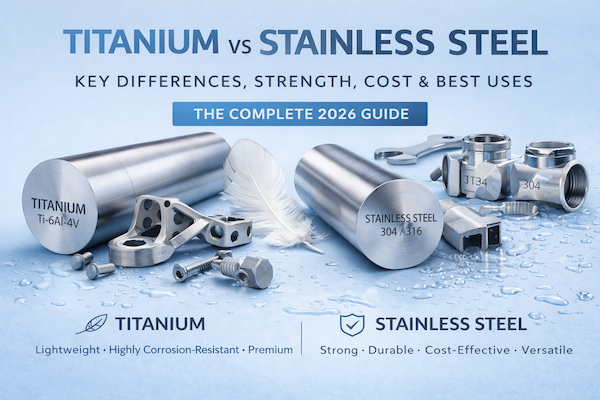
Material selection illustrates this advantage clearly. Nordic and Western European manufacturers frequently work with stainless steel grades 316L and 304, Hastelloy for corrosive environments, and specialized alloys for high-temperature applications. Services like precision machining allow exact material matching to operating conditions, eliminating the compromises inherent in standard equipment designed for broad market appeal.

Custom fabrication transforms manufacturing constraints into competitive advantages by engineering solutions that standard equipment cannot deliver.

The fit-for-purpose design philosophy reduces operational friction. When equipment matches your exact needs, setup times decrease, changeover complexity drops, and operators work more efficiently. Standard equipment forces you to work around its limitations. Custom fabrication eliminates those limitations entirely.

Custom fabrication success in Nordic and Western European manufacturing

Real-world results demonstrate custom fabrication’s transformative impact. Svenska Fönster AB achieved mass customization producing 1800 window pieces per shift while maintaining the flexibility to handle unique specifications for each order. This Nordic manufacturer leveraged custom fabrication lines to achieve what seemed impossible: high-volume production without sacrificing customization capability.

The window manufacturer’s success stems from purpose-built automation that handles variation as efficiently as repetition. Standard production lines excel at identical units but struggle with variation. Custom fabrication lines integrate flexibility into their core design, treating customization as a feature rather than an exception.

Finnish contract manufacturer ITA Nordic demonstrates precision machining and automation integration at scale. Their custom fabrication approach combines robotics with quality systems to serve demanding aerospace, medical, and industrial sectors. The company maintains ISO 9001 and ISO 14001 certifications, proving that custom fabrication supports both quality and environmental responsibility.

Technician adjusting sensors on robotic arm

Manufacturer Production Volume Key Technology Quality Standard
Svenska Fönster AB 1800 pieces/shift Custom automation lines Mass customization
ITA Nordic Contract scale Robotics integration ISO 9001/14001

Quality certifications matter enormously in European manufacturing. ISO 9001 demonstrates process control and continuous improvement. ISO 14001 proves environmental management system implementation. These certifications open market access and build customer confidence. Custom fabrication providers who maintain these standards offer manufacturers reliable partnerships for critical components.

Customer satisfaction metrics reveal another dimension of custom fabrication value. Leading Nordic manufacturers track Net Promoter Scores (NPS) to measure customer loyalty. Finnish operations like those detailed here consistently achieve high NPS scores by delivering precisely what customers need, when they need it.

Pro Tip: When evaluating custom fabrication partners, prioritize those with relevant quality certifications and automation capabilities. The combination ensures both current capability and future scalability as your production requirements evolve.

The Nordic success stories share common threads: investment in purpose-built equipment, integration of automation where it adds value, and commitment to quality systems that ensure consistency. Advanced CNC capabilities enable the precision these manufacturers require while maintaining the flexibility that makes custom fabrication valuable.

Innovations and modularity: optimizing costs and complexity

Modularity revolutionizes custom fabrication economics by transforming one-off projects into repeatable building blocks. Valmet’s modular approach to paper machines reduced engineering lead time and costs while enabling industrialized batch production of customized equipment. The company shifted from designing each machine from scratch to assembling proven modules in customer-specific configurations.

The impact on project timelines and costs is substantial:

Approach Engineering Lead Time Production Cost Logistics Complexity
Traditional custom 12-18 months High variability Complex coordination
Modular custom 6-9 months Predictable batches Standardized logistics

Modular design doesn’t sacrifice customization. It structures it intelligently. Core modules handle standard functions while interface points allow customer-specific adaptations. You get the reliability of proven designs with the flexibility of custom engineering where it matters most.

Hybrid manufacturing takes optimization further by combining additive and subtractive processes. Rosendahl Nextrom reduced parts count, welds, and overall mass through hybrid manufacturing that builds complex geometries additively then machines critical surfaces to final tolerances. Fewer parts mean fewer potential failure points, simpler assembly, and reduced inventory complexity.

Implementing modular and hybrid approaches follows a clear workflow:

  1. Analyze your product portfolio to identify common functional requirements across variants
  2. Design standard modules for repeated functions while isolating customization points
  3. Evaluate which components benefit from hybrid manufacturing based on geometry and volume
  4. Integrate surface treatment capabilities to ensure module interfaces meet assembly requirements
  5. Establish quality gates that verify both module performance and assembled system function

Design for Manufacturing and Assembly (DFMA) principles maximize these benefits. DFMA systematically reduces part count, simplifies assembly, and optimizes manufacturing processes. When applied to modular custom fabrication, DFMA creates the best of both worlds: manufacturing efficiency with product flexibility.

Infographic modularity boosts efficiency key points

Pro Tip: Apply DFMA analysis early in your custom fabrication project. The methodology identifies cost reduction opportunities that become locked in once designs finalize, and precision machining services can then execute the optimized designs efficiently.

The modularity revolution extends beyond mechanical design. Software and control systems benefit equally. Standardized control modules with configurable parameters allow electrical and automation engineering to scale alongside mechanical modularity. Your operators learn one control philosophy that applies across product variants, reducing training time and operational errors.

Evaluating costs and sustainability in custom fabrication

Upfront investment in custom fabrication typically runs 20 to 40 percent higher than standard equipment. This cost differential stops many manufacturers from considering custom solutions. Yet total cost of ownership analysis reveals that custom fabrication delivers lower lifetime costs through compliance savings, higher uptime, and waste reduction.

Consider a pharmaceutical manufacturer choosing between standard and custom mixing equipment:

Cost Factor Standard Equipment Custom Fabrication
Initial purchase $180,000 $245,000
Compliance modifications $55,000 $0 (built in)
Annual maintenance $18,000 $12,000
Waste from poor fit $25,000/year $8,000/year
10-year TCO $598,000 $415,000

The custom solution costs $65,000 more initially but saves $183,000 over ten years. Compliance is built in rather than retrofitted. Maintenance drops because materials and design match actual operating conditions. Waste decreases because the equipment does exactly what the process requires.

Uptime improvements deliver additional value not captured in direct cost comparisons. When equipment fits your process perfectly, unplanned downtime decreases. Changeovers happen faster. Quality issues from equipment limitations disappear. These operational improvements compound over time, widening the advantage of purpose-built solutions.

Sustainability considerations increasingly drive custom fabrication adoption. European metal fabrication markets grow partly because sustainability, reshoring, and Industry 4.0 automation make custom fabrication economically attractive while meeting environmental goals.

Key sustainability benefits include:

  • Material optimization reducing raw material consumption by 15 to 25 percent
  • Energy efficiency from right-sized equipment matching actual loads
  • Waste reduction through precise process control
  • Longer equipment life from proper material selection
  • Recyclability designed into end-of-life considerations

Nordic manufacturers particularly value sustainability certifications. EcoVadis ratings assess environmental and social responsibility across supply chains. Nordic Swan ecolabel identifies products meeting strict environmental criteria. Swedish manufacturing operations often require suppliers to demonstrate environmental management systems and continuous improvement in resource efficiency.

Reshoring trends amplify custom fabrication’s value proposition. As European manufacturers bring production closer to end markets, they need flexible equipment that handles smaller batches economically. Custom fabrication with modular design enables this flexibility while Industry 4.0 automation offsets higher European labor costs.

The automation integration matters enormously. Gear manufacturing capabilities combined with smart sensors and data analytics create self-optimizing production systems. These systems adjust parameters in real time, predict maintenance needs before failures occur, and continuously improve efficiency without human intervention.

Explore custom fabrication solutions with MegaMETA

Transforming these insights into production reality requires a partner who understands both the technical requirements and the business imperatives driving your manufacturing decisions. MegaMETA brings precision CNC machining expertise and comprehensive fabrication capabilities to manufacturers across Nordic and Western Europe.

https://www.megameta.lt/

Our Lithuanian location provides strategic access to Nordic and Western European markets while maintaining the quality standards and certifications your industry demands. From forging projects requiring specialized expertise to precision machining of complex components, our integrated approach combines CNC machining, gear manufacturing, casting, welding, sheet metal fabrication, and surface treatment services with assembly, laser marking, labeling, and warehousing.

Whether you’re scaling mass customization, optimizing existing designs through modularity, or developing entirely new custom fabrication solutions, MegaMETA delivers the technical capability and manufacturing flexibility your 2026 production goals require. Contact us to discuss how custom fabrication can transform your manufacturing efficiency and product customization capabilities.

Frequently asked questions about custom fabrication

What industries benefit most from custom fabrication?

Pharmaceutical, food processing, chemical, aerospace, medical device, and specialized industrial equipment manufacturers gain the greatest advantage from custom fabrication. These industries face strict regulatory requirements, need specific material properties, or require unique geometries that standard equipment cannot accommodate efficiently.

How does custom fabrication improve production flexibility?

Custom fabrication builds flexibility into equipment design rather than forcing processes to adapt to standard machinery limitations. Purpose-built systems handle product variations efficiently, reduce changeover times, and accommodate future modifications without major equipment replacement. Modular approaches further enhance flexibility by allowing configuration changes through module substitution rather than complete redesigns.

What certifications ensure quality in custom fabrication?

ISO 9001 certification demonstrates quality management system implementation and continuous improvement commitment. ISO 14001 proves environmental management capability. Industry-specific certifications like cGMP compliance for pharmaceutical equipment or ASME standards for pressure vessels provide additional assurance. Request certification documentation and audit rights when selecting custom fabrication partners.

Is custom fabrication sustainable compared to standard methods?

Custom fabrication typically delivers superior sustainability through optimized material usage, right-sized energy consumption, reduced waste, and longer equipment life from proper material selection. Purpose-built equipment operates more efficiently than oversized standard alternatives, and design-for-disassembly principles enable better end-of-life recycling. European manufacturers increasingly choose custom fabrication specifically for its sustainability advantages.

How can I get started with a custom fabrication provider?

Begin by documenting your specific requirements, including production volumes, material specifications, regulatory requirements, and performance criteria that standard equipment cannot meet. Contact experienced providers to discuss feasibility, timeline, and cost estimates. Request references from similar applications and review quality certifications. A detailed project specification and clear success criteria ensure alignment between your needs and the provider’s capabilities.

Article generated by BabyLoveGrowth